
AIFrameEngine
A real-time frame generator (using RIFE) and spatial upscaler (using bicubic/fsr easu) for games.
Demo video
What it does
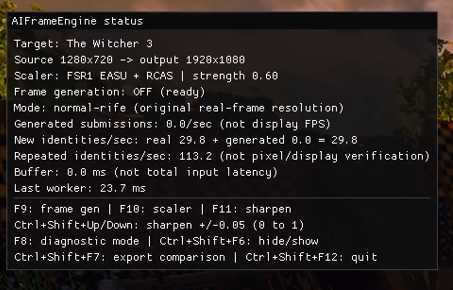
AIFrameEngine is a real-time frame generator and upscaler designed to improve gaming performance on lower-end devices. It functions as a custom compositor, utilizing RIFE (Real-Time Intermediate Flow Estimation) for frame interpolation alongside bicubic and FSR EASU algorithms for spatial upscaling, effectively bridging the gap for hardware that doesn't natively support modern frame generation.
Inspiration
The rising costs of modern GPUs make it increasingly difficult for the average person to keep up with the demands of newer games. While upscaling technologies offer massive performance boosts, advanced, hardware-accelerated frame generation (like DLSS 3) is locked behind the newest graphics cards, leaving older or budget-friendly GPUs (like the GTX and RTX 20 series) behind. This gap inspired me to build AIFrameEngine to bring smoother gameplay to a wider range of hardware.
How we built it
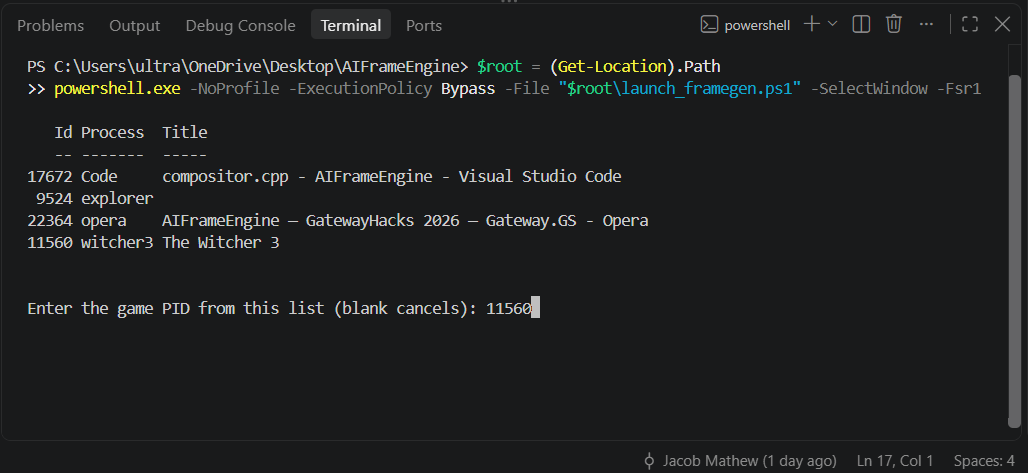
This project was a month-long endeavor and my first time tackling a systems-level architecture of this scale. I built a standalone C++ compositor executable that performs real-time frame capture and execution using Windows Graphics Capture and Direct3D 11. To drive the AI models, I leveraged DirectML and ONNX Runtime to execute the RIFE and upscaling algorithms. I immersed myself in research, utilizing AI tools, video tutorials, and peer guidance to piece together this complex pipeline.
Challenges we ran into
Diving into low-level systems programming as a beginner came with a steep learning curve. I encountered numerous bugs, memory management hurdles, and performance bottlenecks. Furthermore, balancing latency with visual fidelity is a highly complex problem. Currently, the engine is not a complete replacement for commercial technologies like Lossless Scaling or native DLSS/FSR, as it introduces some added latency and only a minimal increase in overall sharpness.
What's next
While the engine has room for improvement regarding latency and image clarity, I believe this hybrid approach has massive potential. Future research and development will focus on optimizing the pipeline to reduce input lag and refine the upscaling algorithms, pushing it closer to a viable, lightweight alternative for budget gamers.
Screenshots
0 comments
Sign in to upvote this project or leave the team a comment.